Investing in real estate:

facts, analyses and insights

A clear overview of what real estate investments entail, how they work and which factors determine success.

Real estate in Belgium:

A market with stability and long-term growth

Investing in real estate with a long-term vision

A combination of value growth and stable rental income

Real estate is a smart way to grow your wealth. With the right investment you enjoy a combination of increased value and stable rental income.

We carefully select interesting real estate opportunities with a focus on return, quality and future value. Discover how you can invest in real estate today and build a strong and sustainable portfolio step by step.

let yourself be guided

The most important concepts clearly explained

Step by step explanation

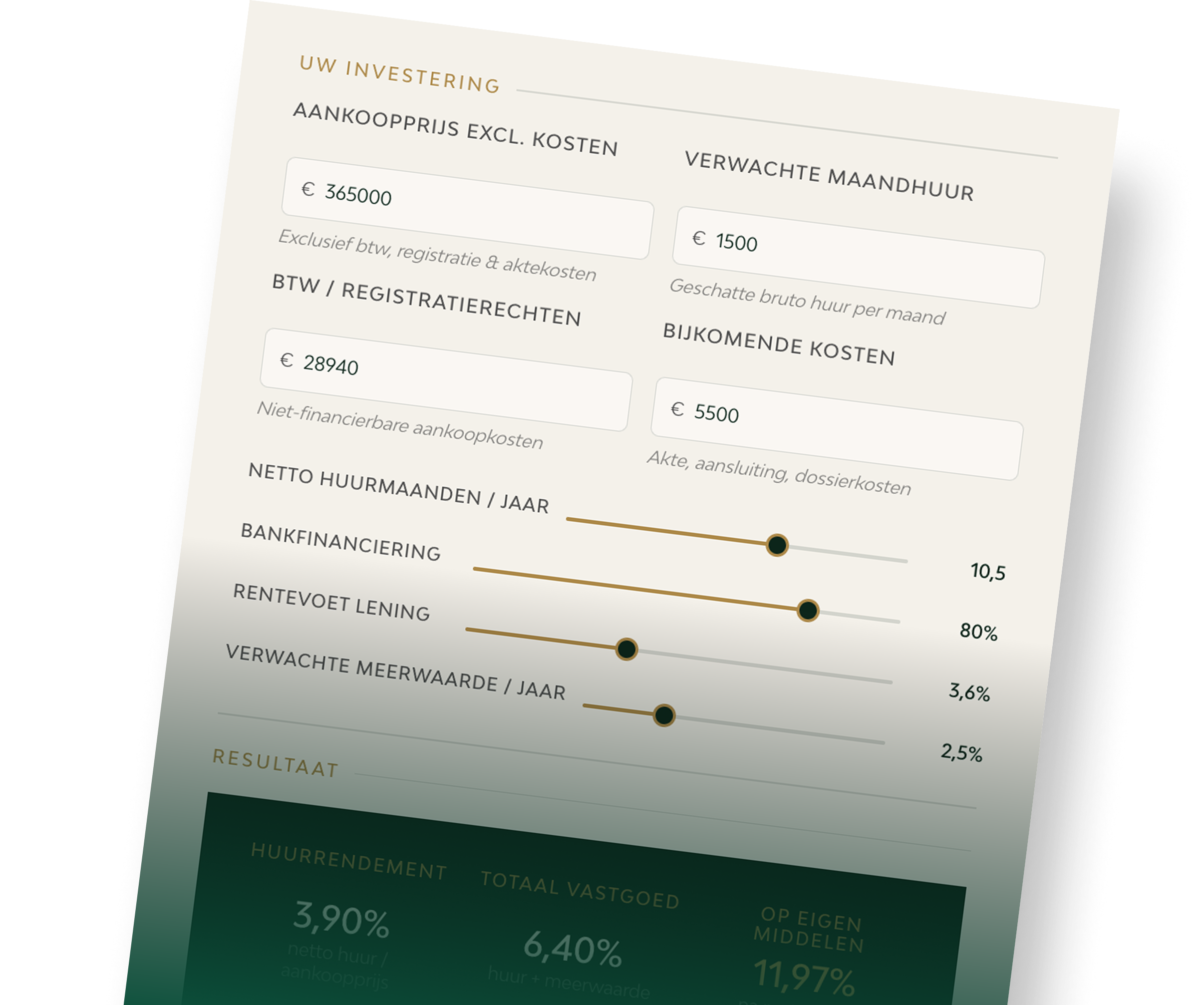
Return on real estate is calculated in different ways. Terms such as gross and net return, cash flow and added value are often used, but do not mean the same thing.

Make an appointment

Gross return

Gross return is a first, simple measure to estimate the return on a real estate investment. You calculate it by dividing the annual rental income by the purchase price of the property. It does not take into account costs such as taxes, maintenance or vacancy and mainly serves to compare projects.

Net return

Net return shows what is actually left after all costs have been included. You start from the annual rental income and deduct, among other things, property tax, maintenance, insurance, management costs, vacancy and any management costs. Divide that net amount by the total investment (purchase price + costs). Net return therefore provides a more realistic picture of what your investment really yields annually.

Cash flow

Cashflow shows what you actually have left (or shortfall) in your account each month. You start from the rental income and deduct fixed costs such as syndic, insurance and maintenance, as well as your monthly loan costs if you finance. The result is your monthly surplus or adjustment. Cash flow therefore says something about your daily affordability, regardless of the added value upon sale.

Long-term added value

Long-term added value is the increase in value of your real estate between purchase and sale. You buy today at a certain price and sell later at a higher market value. The difference, after deduction of any sales costs, is your added value. This is influenced by location, scarcity, energy performance and general market growth. Added value occurs over several years and forms an important part of the total return.

Break-even scenarios

Break-even scenarios show when your investment pays for itself. You calculate at what point the total rental income is equal to your entire investment, including purchase and annual costs. From that point on you start making effective profits. Break-even helps estimate how much time is needed to recover your initial investment and how sensitive your investment is to rent, costs or vacancy.

The risks:

What you need to know before you invest

Interest rate increases

Interest rate increases mainly affect the return when you finance (partly) with a loan. If interest rates rise, your monthly payment will increase and your cash flow will decrease, while your rental income will not automatically follow suit. Even with refinancing or variable interest rates, a higher interest rate can noticeably increase your total costs. The impact depends on your own contribution, term and interest formula, but it remains a factor that it is best to include in your calculation and buffer in advance.

Unexpected costs

Unexpected costs can put pressure on the return on an investment. Consider technical repairs, structural defects, replacement of installations or additional work on the common parts. Especially in older buildings, such costs are difficult to estimate exactly in advance. The impact depends on the condition of the building and the quality of implementation, but a realistic maintenance buffer in your calculation is essential to absorb surprises.

Vacancy

Vacancy has a direct impact on the return on an investment. When an apartment is temporarily not rented, fixed costs such as financing, insurance and common charges continue as usual. The extent to which vacancies occur largely depends on location, rental prices, energy performance and general market demand. A correct assessment of rentability is therefore essential in any return calculation.

Regulations

Regulations can have a direct impact on the profitability of an investment. Stricter energy standards, renovation obligations or tax changes may entail additional costs or affect rentability. Local rules regarding rental or permits can also change over time. Anyone investing should therefore take into account the current legal framework and possible future adjustments that could have an impact on value and return.

Market fluctuations

Market fluctuations can affect the value and return of real estate. Evolutions in supply and demand, economic growth, interest rates or purchasing power can cause prices to temporarily rise or cool. The rental market can also become more sensitive in certain periods. Real estate generally remains a long-term investment, but anyone who gets involved should take into account possible fluctuations in value and rentability in the short and medium term.

Liquidity

Liquidity determines how quickly you can convert an investment back into cash. Real estate is less liquid than shares, for example: a sale requires time, negotiations and additional costs. In periods of lower market demand, it may also take longer to find a buyer or the price may have to be adjusted. Anyone who invests in real estate should therefore do so with a sufficiently long horizon and without being dependent on a quick sale.

What costs are added to your purchase?

An overview of all costs

In addition to the purchase price, the purchase of real estate involves various one-off and recurring costs that determine the final return.

  • Registration fees or VAT
  • Notary costs
  • Deed costs
  • General costs
  • Annual costs
  • Insurance
  • Rental management (optional)
let yourself be guided

Discover our investment events.

Come by and meet your future investment.

ALL EVENTS

The 5 elements that determine the value of an investment

01

Location

A good location ensures lasting demand, both among buyers and tenants. Proximity to public transport, shops, schools, employment and green space increases the value.

02

Rental potential

The value of an investment depends on what you can realistically rent out and how quickly you find a tenant. A fair rental price, the right type of unit and a match with the local rental profile limit vacancy.

03

Quality, architecture & sustainability

Quality determines attractiveness and costs. Well thought-out layouts, light, outdoor space and sustainable techniques ensure higher residential value, better rentability and fewer surprises in the long term.

04

Added value

In addition to rental income, the increase in value between purchase and sale is also a factor. Scarcity, neighbourhood development, energy performance and general market growth determine how much your real estate can yield later.

05

Market fluctuations

The market moves: interest rates, purchasing power and supply/demand can influence the pace and price. Those who invest with a margin, a long horizon and realistic figures remain less sensitive to short fluctuations.

More information?

Please contact us.

Who might be interested in investing in real estate?

Different profiles, different objectives

Investing in real estate appeals to a wide group of people. For some it is a first step in using savings in a targeted manner, for others, it is a way to build financial stability in the long term.

Singles, families and people who are thinking ahead to retirement often choose real estate to spread risks and preserve value. Anyone who invests with a view to the future of their children or wants to diversify their portfolio will also find real estate a tangible and well-organised investment.

Frequently asked questions about investing in real estate.

Those who invest in real estate often encounter similar questions about returns, risks and practical choices. Here we answer the most frequently asked questions in a clear and neutral manner.

Is investing in real estate still interesting in 2026?

Real estate remains a relevant long-term choice for many investors, especially due to its tangible value and the possibility of rental income and added value. The attractiveness depends on location, purchase price, financing and energy performance. Anyone who calculates realistically and focuses on quality and a prime location can also build a stable investment in 2026.

A realistic return depends on location, type of property and financing structure. In practice, a net return is often considered that takes costs, vacancy and taxes into account. In addition to the annual return, the potential added value in the longer term also plays an important role in the overall picture.

Important risks are vacancy, interest rate increases, unexpected costs and changes in regulations. Market fluctuations can also temporarily affect value and rentability. A well-considered purchase, correct pricing and sufficient financial buffer help to mitigate these risks.

A good location attracts sustained rental demand and has strong accessibility. In Brussels, neighborhoods such as Ixelles/Saint-Gilles (expats & young professionals), Auderghem/Uccle (green spaces & families), and Laeken (growth potential) often perform well, depending on your target audience. In Flanders, cities like Leuven are strong due to jobs, education, and mobility. Always check the micro location, facilities and energy performance: that determines rentability and value.

New construction usually requires a higher purchase price, but often offers lower maintenance costs and better energy performance. This can provide more comfort, lower monthly costs and greater rentability. The total picture, including costs and future obligations, determines whether new construction is interesting.

In Belgium, the rent can in principle be adjusted annually based on the health index, according to a legal formula. Indexation helps to keep rental income in line with inflation. The applicability depends on the energy performance certificate and the applicable regulations.

The sales value depends on market conditions, location, energy performance and the condition of the building. Real estate is less liquid than other investments and takes time to sell. A high-quality and well-located property usually retains its value better.

That depends mainly on your long-term plans and your flexibility. Buying requires more input and entails fixed costs, but you do build up capital and are less dependent on rising rents. Renting usually requires less starting capital and gives you more room to move, build up ownership. The right choice becomes clearer when you compare your budget, your plans for the coming years and your need for security versus flexibility.

More about
YOBO

Contact us

Do you have specific questions about investing? Are you considering a purchase, but not sure if it fits your budget or goals? Our project advisors are think along to help.